Day Off
Well, I intended to write this the day after my earlier post. Look at me and my motivational skills. Anyway, as I mentioned, on our holiday we had a day off. And on our day off we trundled over the North York Moors to Helmsley. Which I'm sure has an interesting enough history itself as a little town but mostly I only had to time to use and abuse it for its sausage-roll- and ice-cream-vending facilities. Because what I did with my three hours there was visit Helmsley Castle - or rather the ruins of it.
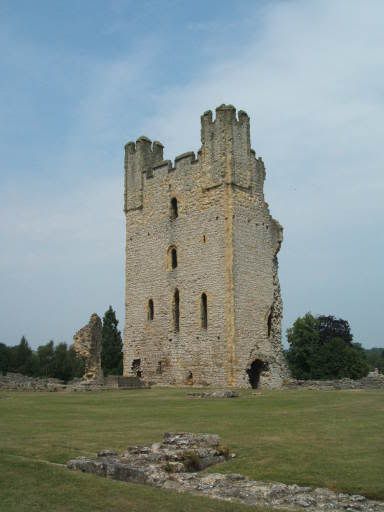
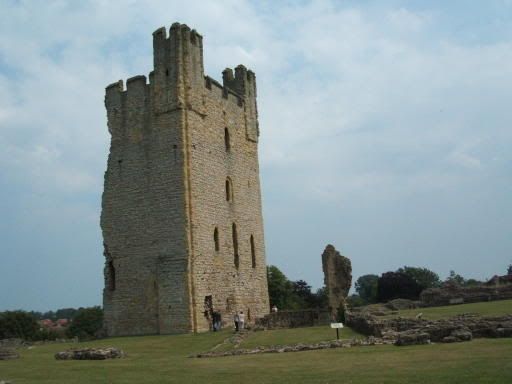
I can't be bothered being its tour guide...its official site and brief history is here although 'dismantled the defences' is a bit of a euphemism for 'blew up almost everything in sight.' Including, as can be seen above, the side of the keep facing the town (symbolic, obviously, to watch that come crashing down if you were a peasant in the time of the Civil War). That tower really is very high, especially considering that it is 12th- and 13th-century workmanship.
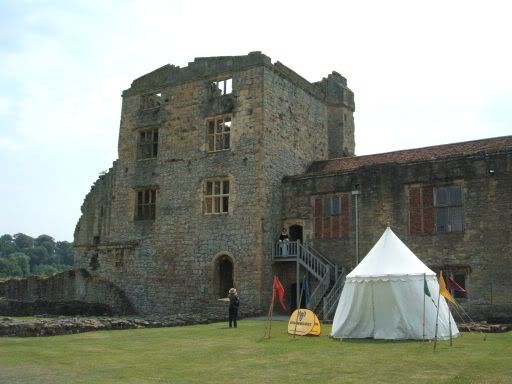
Still standing on the other side of the inner bailey is the old living quarters, remodelled into an Elizabethan house. This is the view from inside the higher part, looking back up at those windows you can see:
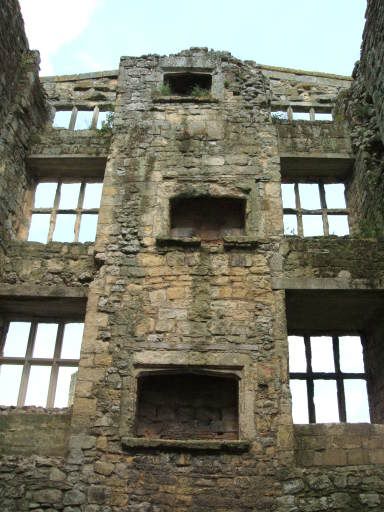
I do love the way social standing was determined by fireplace size.
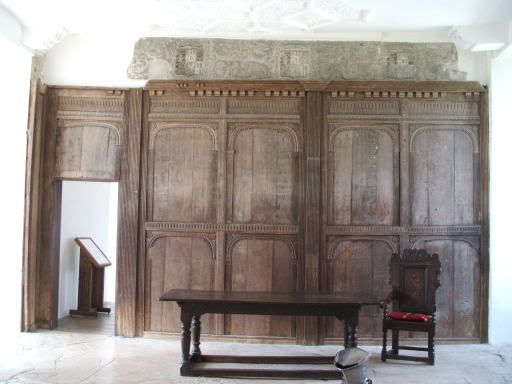
Inside the part that is still protected from the elements (note all the bricked-in windows thanks to the window tax), there remain traces of the Tudor lifestyle. Wood panelling, a little ceiling plaster and even a section of a frieze displaying their coat of arms.
But mostly, what was there was ruination and more than that - destruction. The very human thing of saying 'this was yours and it showed you had power. If I destroy it, I'll feel good.' Maybe they did fear it could be used as a Royalist stronghold again...it's possible. But I think mostly it was just rebels tearing down the strongholds of the old regime - see that other tiny little bit of wall left standing higher in front of the tower? That's all that remains of the castle's chapel. Which was catholic, obviously, and hence deserving of Roundhead demolition. Ah, how the UK loves its traditions...of religious hatred...
Anyway. A very pretty ruin it undoubtedly was, and interesting in its history. I wandered round it with the aid of an audio guide (rather excessively long-winded although it did have a great dry sense of humour and say things like "if you want, you can go down those steps to the cellar...if you like dark, and somewhat damp places.") until it was time to go back to the minibus and head back to our base village of Osmotherly. Where, and this final photo is included purely for jes, we found a village summer fair in full swing down the main street. Here is the traditional sport of welly-wanging*. (Welly exiting top of frame.)
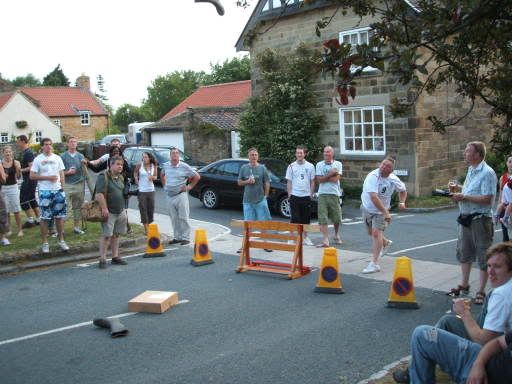
* yes, now more often known as welly-throwing in those villages even peripherally aware of the outside world.
I can't be bothered being its tour guide...its official site and brief history is here although 'dismantled the defences' is a bit of a euphemism for 'blew up almost everything in sight.' Including, as can be seen above, the side of the keep facing the town (symbolic, obviously, to watch that come crashing down if you were a peasant in the time of the Civil War). That tower really is very high, especially considering that it is 12th- and 13th-century workmanship.
Still standing on the other side of the inner bailey is the old living quarters, remodelled into an Elizabethan house. This is the view from inside the higher part, looking back up at those windows you can see:
I do love the way social standing was determined by fireplace size.
Inside the part that is still protected from the elements (note all the bricked-in windows thanks to the window tax), there remain traces of the Tudor lifestyle. Wood panelling, a little ceiling plaster and even a section of a frieze displaying their coat of arms.
But mostly, what was there was ruination and more than that - destruction. The very human thing of saying 'this was yours and it showed you had power. If I destroy it, I'll feel good.' Maybe they did fear it could be used as a Royalist stronghold again...it's possible. But I think mostly it was just rebels tearing down the strongholds of the old regime - see that other tiny little bit of wall left standing higher in front of the tower? That's all that remains of the castle's chapel. Which was catholic, obviously, and hence deserving of Roundhead demolition. Ah, how the UK loves its traditions...of religious hatred...
Anyway. A very pretty ruin it undoubtedly was, and interesting in its history. I wandered round it with the aid of an audio guide (rather excessively long-winded although it did have a great dry sense of humour and say things like "if you want, you can go down those steps to the cellar...if you like dark, and somewhat damp places.") until it was time to go back to the minibus and head back to our base village of Osmotherly. Where, and this final photo is included purely for jes, we found a village summer fair in full swing down the main street. Here is the traditional sport of welly-wanging*. (Welly exiting top of frame.)
* yes, now more often known as welly-throwing in those villages even peripherally aware of the outside world.
posted by skittledog @ 10:18 pm
7 comments


7 Comments:
A window tax? Who instigated that?
Lorde Wylliam Gaytes?
That wood panelling is gorgeous.
But Rian wants to know who lives in the festive white tent?
A Jousting Lord with Flags Flying?
Oh wow, it actually exists. Hee hee hee.
And one of them really sucks... that boot can't have gone 2 meters.
I am somewhat tempted to try it now, just to see how hard it is.
I think that boot may lie where it was thrown back by people further down the street, but some of the throwers really were very drunk so I'm not sure. The funniest ones were when a welly flew off sideways and hit house windows or knocked small children unconscious (never quite happened but got really close). Oh, one got stuck in a tree too.
Rian, I somehow managed to walk all round that little tent without ever investigating. Someone else said later that it had a mini exhibition about armour in, though.
And Myo, window tax. Not that interesting, but you do see blocked-up windows quite frequently in really old houses in Britain.
In Japan they were taxed on the width of the building that faced the street. Hence the very many old and thin buildings. Create a tax and people will find a way around it.
I've tried that with council tax. They sent me a letter all in red.
And I thought curling was a bizarre sport.
Post a Comment
<< Home